
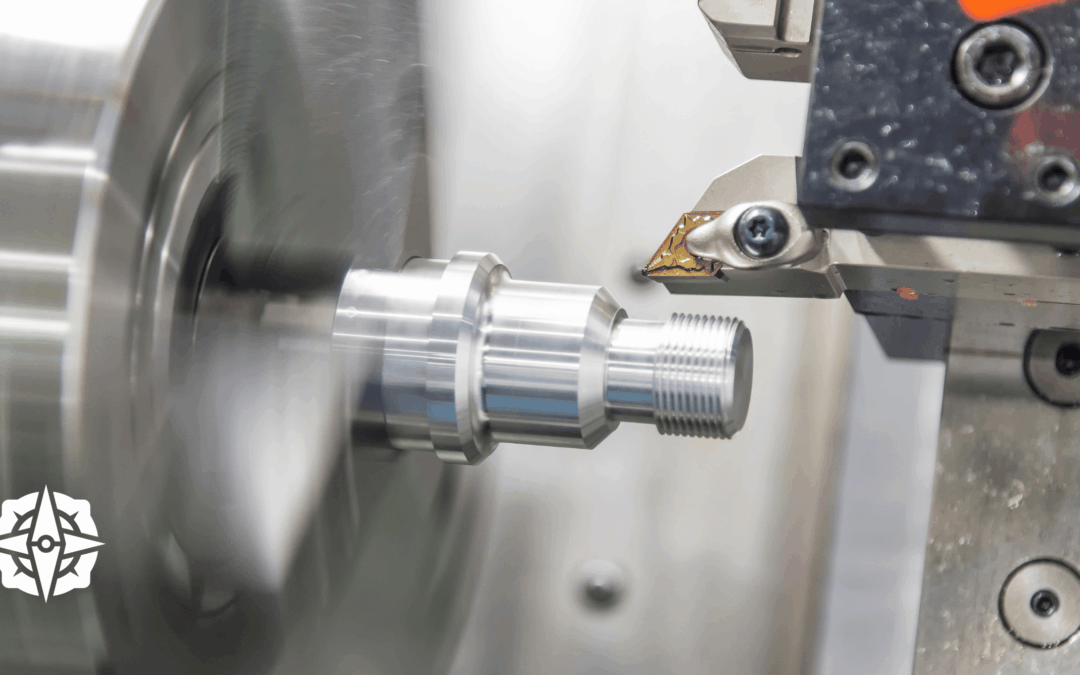
Choosing the Right Machining Process
When manufacturing small, high-precision parts, the choice often comes down to Swiss machining and turning in a CNC lathe. Although both processes have great capabilities, their applications are different. Choosing the right process for your part can significantly affect component performance, production cost, and cycle times.
In this article, we’ll explain Swiss machining and CNC turning, covering how they work, their applications, and their advantages and disadvantages. We’ll also take a look at the fundamental differences between the two processes and the factors to consider when choosing the right method for your part.
What is Swiss Machining?
Swiss machining is a CNC machining process used to produce higher volumes of small components that may require extremely tight tolerances. Developed in the 19th century in Switzerland to create tiny watch parts, it’s now widely used to manufacture intricate, high-precision parts in industries such as medical and aerospace, where very minor deviations can affect performance and compliance.
The machine used for Swiss machining is called a Swiss lathe or a CNC Swiss machine. It’s generally used for materials such as stainless steel, brass, carbon steel, nickel alloys and aluminum.
How does Swiss Machining work?
A Swiss lathe uses a sliding headstock to feed a bar stock through a guide bushing. This bushing holds the bar firmly and extends only the portion to be machined to the tooling area, reducing deflection and enabling tolerances as tight as ±0.0002 inches.
Unlike conventional CNC lathes, Swiss machines have multi-tool capabilities. They can turn, drill, mill, and thread a workpiece into the desired geometry in a single setup, thereby shortening cycle times. CNC lathes with live tooling can produce results similar to the Swiss machine on larger diameter parts.
Most Swiss lathes feature a sub-spindle that allows them to pick up the workpiece before completion and machine on the backside without any additional operations.
Advantages of Swiss Machining
- Swiss machining offers higher precision and tighter tolerances than traditional CNC machining, particularly for small, slender components.
- Thanks to their multi-Axis capabilities, Swiss lathes can perform multiple milling and turning operations simultaneously.This can reduce cycle times and minimize waste.
- Swiss machining can create complex features such as holes and threads on small components.
- Modern Swiss machines can run unattended, completing part machining and achieving consistent quality with minimal manual intervention.
Disadvantages of Swiss Machining
- Swiss CNC machines are specialized equipment that require higher upfront costs than traditional CNC turning machines.
- They require specialized training and skill to operate.
- Swiss lathes are primarily used to machine parts with diameters below 32mm. If the part has a larger diameter or a very short length, Swiss machining may not be appropriate.
What is CNC Turning?
CNC turning is a machining process used for producing cylindrical and conical components with high precision. Like Swiss machining, it’s a subtractive manufacturing process that shapes a workpiece into the desired geometry by progressively chipping away portions of the material. This process is carried out using CNC lathes, also known as CNC turning machines or CNC turning centers.
How does CNC Turning work?
In CNC turning, a chuck or collet attached to the lathe’s spindle holds the workpiece tightly and rotates it at a high speed. As the workpiece rotates, a cutting tool mounted on the lathe’s carriage engages it and removes excess material, leaving behind a precision-machined component.
The entire process of CNC turning is guided by a G-code, a pre-programmed set of instructions generated from a 3D model of the part. This G-code dictates both the spindle speed and the cutting tool’s movement, ensuring the workpiece is machined with high accuracy and enabling repeatability.
Advantages of CNC Turning
- CNC turning can achieve tolerances as tight as ±0.0005 inches, higher than what’s achievable with manual turning.
- It can produce identical parts with consistent quality, regardless of the volume.
- Although not as versatile as Swiss lathes, CNC turning machines can create features that are difficult to achieve with manual lathes.
- Compared to manual turning, CNC turning reduces production time and delivers superior surface finishes.
- CNC turning is guided by a computer program, so it requires minimal human intervention, resulting in reduced human errors.
Disadvantages of CNC Turning
- CNC turning is best used for producing larger diameter cylindrical components. It’s not as effective for machining small diameter long, cylindrical parts, as deflection can occur during machining.
- CNC turning centers with live tooling have a high initial setup cost.
- CNC lathes don’t have as many tooling capabilities as Swiss machining, requiring additional operations, resulting in a longer production cycle.
Swiss Machining Vs CNC Turning: Key Differences
Here, we’ll cover the fundamental differences between Swiss machining and CNC turning. Understanding these differences can help you decide which process is right for your part.
Headstock movement
Swiss machines use a sliding headstock to move a bar stock axially through a guide bushing. With this setup, the machining is done close to the support point, enabling greater accuracy.
In contrast, CNC turning centers use a fixed headstock to clamp the workpiece in a chuck or collet, where it rotates during machining. This works effectively for components with large diameters but is not ideal for parts with thin diameters.
Guide bushing
Swiss lathes have a guide bushing that provides continuous support for the workpiece during machining, minimizing deflection. This tight support also enables the cutting tool to make deeper cuts in a single pass rather than multiple shallow ones.
CNC lathes don’t have a guide bushing. They hold workpieces in place using a chuck and don’t provide support in the center section. That’s why there is a possibility of deflection when used for long or very thin workpieces.
Machining capabilities
Swiss machines are generally equipped with multiple axes, allowing them to perform operations such as milling, turning, and threading simultaneously in one cycle. As the workpiece advances through the guide, each tool engages with it to achieve the desired geometry.
CNC lathes, typically, don’t have the multi-tool capabilities as a Swiss machine. When multiple cutting tools are required, they are usually applied in sequence rather than simultaneously. This method requires additional machining operations, resulting in a longer production cycle.
Part size, geometry, and tolerance
Swiss lathes are best for manufacturing small, complex parts with diameters less than 32mm. They are most effective for components with length-to-diameter ratios greater than 3:1. In terms of tolerance, Swiss lathes can achieve ±0.0002 inches.
In contrast, CNC turning centers work best for strong, short components with larger diameters. They are not recommended for thin and long components. CNC lathes can achieve surface finishes within ±0.0005 but can’t consistently handle tighter tolerances.
Side-by-side comparison of Swiss machines and CNC turning centers:
|
Feature |
Swiss machines |
CNC turning centers |
|
Best for |
Small, complex parts requiring extreme precision |
Thick, shorter parts with tighter tolerances |
|
Tolerances |
Up to ±0.0002 |
±0.0005 |
|
Headstock movement |
Sliding headstock |
Fixed headstock |
|
Workpiece support |
Guiding bushing provides strong support |
Clamped in chuck or collet. Less support for thin or long parts |
|
Machining capabilities |
Multiple tools running simultaneously |
Fewer tools. Run sequentially |
|
Part geometry |
Long, thin parts with diameters less than 32mm |
Short, strong parts with larger diameters |
What to consider when choosing between Swiss machining and CNC turning?
When it comes to manufacturing high-precision parts, the type of machining process you choose can affect the quality and performance of your components. Making the right choice can also reduce your production cycle and cost. You get your components faster and can innovate at a greater speed.
Here are three important factors to consider when deciding whether to use Swiss machining or CNC turning for your parts:
Part geometry
If the part you want to produce is long and thin, with complex features, choose Swiss machining. This process is also suitable for parts with a high length-to-diameter ratio. For example, Swiss machining is commonly used for bone screws with diameters as small as 2mm.
However, if the part is short and has a diameter larger than 32mm, CNC turning is the most appropriate option. Parts you can produce with this process include hydraulic fittings, drive shafts, axles, and medical implants.
Tolerance requirements
If you operate in a highly regulated industry such as medical, defense, or aerospace, precision is paramount. According to Tooling U-SME, a slight deviation from the tolerance requirements can result in performance, safety, reliability, and compliance issues.
For parts requiring extremely tight tolerances, the most effective equipment to produce them is a Swiss-type CNC machine. We are talking about components requiring tolerances as tight as ±0.0002 inches. Trying to manufacture this on a CNC turning machine would likely cause deflection issues.
However, if your parts require moderate tolerance, CNC turning would be more appropriate and cost-effective.
Production volume
Another important factor to consider is the number of parts you need to produce. For a low-volume job, say 1-100 parts, using a CNC lathe will generally be more cost-effective.
If you’re producing thousands of parts, especially small, complex parts, Swiss machining becomes more effective. This is because the high volume would offset the setup cost.
When producing a high volume of parts with complex features, Swiss machining can also shorten your production time. Unlike a CNC lathe, it can deliver the finished part in a single cycle without switching tools, thereby eliminating long production waits.
Applications of Swiss machining vs CNC Turning
Here is a table showing some use cases of these methods across different industries.
|
Industry |
Swiss Machining |
CNC Turning |
|
Aerospace |
Fasteners, fuel system components, and electrical connectors |
Gear components, bushings, and hydraulic shafts. |
|
Medical |
Bone screws, small orthopedic implants, and implant pins. |
Larger implants and surgical housings |
|
Automative |
Sensors, fuel injector components, and gears. |
Transmission shafts, drivetrain components, and bushings |
|
Electronics |
Terminals, heat sinks, and connectors with small diameters |
Housings, terminals, rotors, and connectors |
Conclusion: Which CNC machining method is ideal for my part?
Overall, Swiss machining and CNC turning offer great capabilities for manufacturing parts with extreme accuracy. However, the application of both processes differs.
The best CNC machining process for your part depends on multiple factors, including the part’s geometry, tolerance requirements, and production volume.
How can Compass Precision help?
Choosing between Swiss machining and CNC turning depends on more than part size alone. Compass Precision helps customers evaluate these requirements and connect with the manufacturing partner best suited for the job.
Through our network of 11 specialized U.S. facilities and hundreds of advanced manufacturing assets, we provide access to a broad range of machining capabilities, engineering expertise, and industry-specific certifications. Each program is aligned with the facility best positioned to deliver based on technical requirements, capacity, and application fit.
Our teams also work collaboratively with customers during the quoting process and throughout production to identify manufacturability improvements that reduce cost, improve quality, and increase production efficiency. In one recent program, our team recommended design enhancements that improved the customer’s assembly yield from approximately 70% to more than 95%.
Our shared quality systems and standardized processes help ensure consistency across the network, while our distributed manufacturing model provides flexibility, scalability, and production continuity as program needs evolve.
Whether your part is best suited for Swiss machining, CNC turning, or another precision manufacturing process, our team can help identify the right solution.
Request a Custom Quote
Frequently asked questions
What is the main difference between Swiss machining and CNC turning?
The primary difference between Swiss machining (commonly referred to as Swiss screw machining or screw machine) and CNC turning lies in how the workpiece is held during machining. Swiss machining uses a guide bushing that moves the material while the tools remain stationary. This provides strong support for the workpiece during machining, allowing the cutting to be performed near the support point. For CNC turning, the workpiece is held stationary by a chuck or collet and at one end and may be supported on the opposite end, and the tools move to cut the material.
When should I use Swiss machining instead of CNC turning?
Swiss machining is more effective when producing higher volumes of small diameter (32mm or less), intricate parts that require extreme precision and tight tolerances. They are also ideal for long, slender parts with a length-to-diameter ratio higher than 3:1. Swiss machines can work on parts with very thin diameters, which may not be appropriate for CNC lathes.
When should I use a CNC lathe instead of Swiss machining?
Turning in a CNC lathe is best for producing cylindrical parts over 32mm in diameter. CNC lathes can produce high precision parts and moderate tolerances. They are relatively easy to set up and are more cost-effective for less complex parts.