How Machining Requirements Influence Process Selection
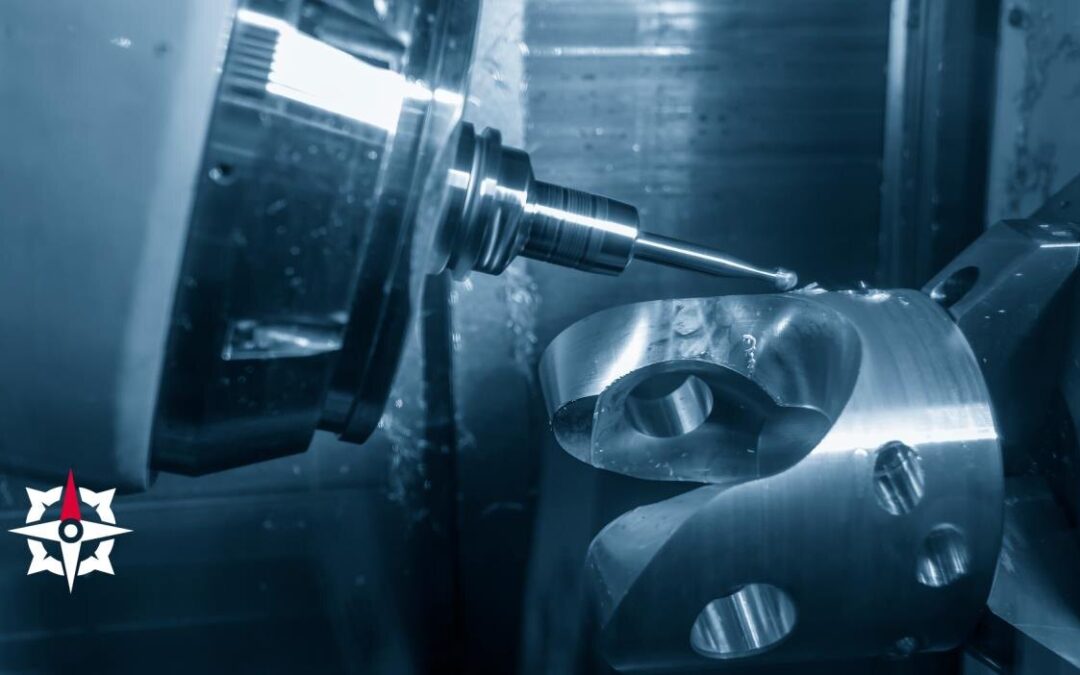
When machining complex components for the aerospace, defense, and medical industries, there is often the need to determine whether 3-axis or 5-axis machining is the better fit for the project. Each process offers distinct capabilities and limitations that can affect production outcomes, operational costs, and cycle times.
In this article, we’ll look at what 5-axis and 3-axis machining are and compare their features and limitations, so you can make the right choice for your manufacturing needs.
To start, here is a quick overview of the differences between the two.
An Overview of the Differences
The main difference between 5-axis and 3-axis machining is the number of ways the cutting tool can move during the manufacturing process.
With 3-axis machining on a vertical machine, the cutting tool operates along X (left and right), Y (front and back), and Z (up and down) axes only. It’s best suited for producing components with relatively simple geometries and features. To machine more complex geometries, additional setups are often required.
On the other hand, 5-axis machining includes all the capabilities of 3-axis machining while adding two rotational axes that rotate about the aforenoted linear axes. These additional axes allow the cutting tool to approach a workpiece from multiple angles, making it easier to machine complex geometries and intricate features in a single setup.
Beyond cutting tool movement, 5-axis and 3-axis machining also differ in cost per part, manufacturing efficiency, cycle times, and applications.
Read on to learn more about 5-axis and 3-axis machining and how they differ.
What is 3-Axis Machining?
 3-axis machining is a machining process where the cutting tool removes material from a workpiece by moving along the X, Y, and Z axes. In this setup, the cutting tool can only approach the workpiece linearly and from limited angles.
As a result, 3-axis machining is best used for producing components with straightforward geometries and easily accessible surfaces. That includes flat plates, pockets, slots, holes, and simple profiles.
3-axis machining is popular for its cost-effectiveness, simplicity, and versatility. Compared with multi-axis machines, 3-axis machines are generally easier and less expensive to set up. They also require simpler CAM programming and less operator training.
However, because the cutting tool can only move along the X, Y, and Z axes, 3-axis machining often requires additional setups when manufacturing components with undercuts, deep cavities, and other complex geometries.
What is 3-Axis Machining Used for?
3-axis machining is generally used to manufacture parts with flat or contoured surfaces positioned perpendicularly to the cutting tool, slots, pockets, holes, and straightforward contours.
Ideal use cases for 3-axis machining include:
- Plates and brackets
- Mold bases
- Jigs and fixtures
- Housing and enclosures
- Prismatic parts requiring fast turnaround
- Parts with pockets, holes, slots, simple profiles and contoured surfaces
Advantages of 3-Axis Machining
Lower production costs
3-axis machines are generally more affordable to set up and operate than multi-axis machines, such as 4-axis and 5-axis machines, especially when producing simple parts. This can mean lower cost per part for simple projects.
Shorter lead times
3-axis machining is faster and easier to set up for simple applications, often requiring less alignment and repositioning. It generally offers shorter lead times for simple parts, making it ideal for prototypes and quick design revisions.
Good accuracy and repeatability
When properly set up and operated, 3-axis machining can achieve high accuracy and repeatability. This makes it suitable for industries such as aerospace and medical that require repeatable, precise part production.
Limitations of 3-Axis Machining
3-axis machining is best suited for producing simple parts; it can struggle with components that require the cutting tool to approach the workpiece from multiple sides or angles.
To machine complex parts, multiple setups are often required. This can make 3-axis machining less cost-effective than multi-axis machining for complex components. Also, each additional setup can increase the production time and risk of errors.
What is 5-Axis Machining?
 5-axis machining is a process in which the cutting tool removes material from a workpiece by moving along five axes simultaneously. In addition to the linear X, Y, and Z axes used in 3-axis machining, it includes two rotational axes that rotate about one or more of the primary linear axes allowing the cutting tool and/or workpiece to rotate during machining.
This enhanced capability allows the cutting tool to work on a workpiece from multiple angles through positional and simultaneous axis motion without requiring repositioning or multiple setups. As a result, 5-axis machining excels at producing parts with complex geometries and intricate details.
One of the main advantages of 5-axis machining over 3-axis machining is that it can produce parts with complex geometries in a single setup. This reduces the need for additional setups, thereby lowering production costs, shortening lead times, and improving accuracy.
Like 3-axis machining, 5-axis machining also has its downsides. 5-axis machines are more expensive, sometimes costing 5 times as much as 3-axis machines. Also, they require more specialized operator training and complex programming to use.
What is 5-Axis Machining Used for?
5-axis machining is generally used to produce complex parts with intricate geometries that are difficult or simply impossible to machine with 3-axis machining.
Ideal use cases for 5-axis machining include:
- Multi-face housings and brackets
- Impellers and turbine blades
- Custom complex prototypes
- Medical implants and precision instruments
- Parts with deep cavities, angled ports, and side holes
Advantages of 5-Axis Machining
Ability to machine complex geometries
5-axis machining can produce parts with contoured surfaces, angled holes, deep cavities, undercuts, and other complex features that are difficult or impractical to machine with a 3-axis setup.
Shorter lead times for complex parts
Unlike 3-axis machining, which sometimes requires additional setups to manufacture complex parts, 5-axis machining can produce many complex parts in a single setup. This can result in shorter lead times, which is beneficial for teams or organizations that need faster production or want to innovate faster.
Improved surface finish and accuracy
5-axis machining allows the cutting tool to approach the workpiece from multiple angles, reducing the need for multiple setups and the potential errors associated with them. When properly set up and operated, it can achieve improved surface finishes and tighter tolerances.
Limitations of 5-Axis Machining
As mentioned earlier, 5-axis machines are more expensive than 3-axis machines. They also require specialized training and complex programming. Therefore, for parts with straightforward geometries, using a 5-axis machine may not be cost-effective and time-efficient.
5-Axis vs. 3-Axis Machining: A Side-By-Side Comparison
|
Feature |
3-Axis Machining |
5-Axis Machining |
|
Number of axes |
Three linear axes: X, Y, and Z |
Five axes: three linear axes (X, Y, and Z) and two rotational axes |
|
Cutting tool movement |
Approaches the workpiece from a limited range of angles |
Approaches the workpiece from multiple angles |
|
Part production capabilities |
Best suited for simple parts with flat or contoured surfaces, pockets, basic 2D contours, and holes |
Ideal for complex parts with contoured surfaces, angled holes, deep cavities, undercuts, and other complex features |
|
Multi-setup requirements |
May need multiple setups to produce complex parts |
It can produce many complex parts with a single setup |
|
Accuracy and repeatability |
High accuracy and repeatability for simple parts. Variations may occur with complex parts that require multiple setups |
High accuracy and repeatability for complex parts |
|
Setup cost |
More affordable |
Can cost 5 times as much as 3-axis machines |
|
Ease of operation |
Easier to set up and operate |
Needs specialized training to set up and operate |
|
Cost per part |
Lower cost for simple parts |
Generally more cost-effective for complex parts |
|
Ideal applications |
Best for producing plates, brackets, mold bases, housings, and other simple components |
Best for producing parts with complex surfaces and features, including impellers, turbine blades, multi-face housings, and custom complex prototypes |
What is 4-Axis Machining?
Beyond 3-axis and 5-axis machining, there is also 4-axis machining, which serves as a middle ground between the two. As the name implies, it has four axes: X, Y, Z, and a rotational axis which rotates about a primary axis and is best suited for parts that require machining around a cylindrical surface.
4-axis machining offers more capabilities than 3-axis machining but less flexibility than 5-axis machining. It’s also generally easier and less expensive to set up than 5-axis machining.
Which is Best for My Parts: 5-Axis, 4-Axis, or 3-Axis Machining?
The choice between the three depends on the complexity of your parts. 3-axis machining is generally more suitable for producing simple parts, while 4-axis and 5-axis machining are best suited for parts with more complex geometries.
If you’re still unsure which to choose, our highly experienced team can help you determine the best machining option for your program. We’d be glad to hear from you.
Discuss your Machining Requirements with us Today!
Contact Compass Precision today to discuss your program requirements and learn how we can support your project. We have hundreds of CNC machines across our platform, including a variety of 3-, 4-, and 5-axis machining centers capability of servicing a wide range of part sizes. We are certified and well equipped to deliver high-precision parts across all major industries.
Why Compass Precision?
A Platform Built with Intention
Our capabilities are built to meet today’s requirements and stay ahead of what programs will demand next. We have the technical depth, the right equipment, and a proven ability to execute on programs that have zero tolerance for error.
Programs Matched to the Right Manufacturing Partner
We pair each project with the shop best positioned to deliver on its requirements, based on process expertise, certifications, capacity, and application fit. Customers engage through a single point of contact while benefiting from access to the most appropriate manufacturing capability within the network.
Capacity Across 11 U.S. Facilities
Each of our machining facilities brings established tenure, trusted reputation, and proven capability on demanding programs. We can distribute production volume, protect schedule integrity across locations, and reduce the concentration risk that comes with relying on a single-site supplier.
Consistent Quality Systems Across All Locations
We maintain standardized quality, documentation, and inspection across our portfolio, with certifications applied at the facility level based on program requirements. Our certifications include AS9100D, ISO 9001:2015, ITAR, CMMC, and AWS. We also maintain consistent documentation, traceability, and inspection standards across our network regardless of which shop is doing the work.
Frequently Asked Questions
What is the difference between 3-axis and 5-axis CNC machining?
3-axis CNC machining uses the X, Y, and Z axes to machine a part, while 5-axis CNC machining adds two rotational axes (typically A and B), allowing the cutting tool and/or workpiece to be positioned at multiple angles during machining.
What are 3-axis and 5-axis machining used for?
3-axis machining is generally used to manufacture parts with flat surfaces, slots, pockets, holes, and straightforward contours, while 5-axis machining is generally used to produce complex parts with intricate geometries that are difficult or simply impossible to machine with 3-axis machining.